




















MR
Monthly Review
READ MONTHLY REVIEW!

Coalition of Labor Union Women IN LABOR'S CORNER

RSS

CASMII
CAMPAIGN AGAINST SANCTIONS AND MILITARY INTERVENTION IN IRAN

The Alternative Information Center
THE ALTERNATIVE INFORMATION CENTER

News from Within Podcast
NEWS FROM WITHIN PALESTINE /
ISRAEL PODCAST


The Electronic Intifada
THE ELECTRONIC INTIFADA

Member, Project Hamad

SDS
JOIN THE NEW SDS

MR GR

Check Out Our Frappr
ADD YOURSELF TO OUR FRAPPR

- - - - - - - - - - - - -

SUBSCRIBE
SEARCH
SERENDIPITY

- - - - - - - - - - - - -
AUTHOR
- - - - - - - - - - - - -
DATE
- - - - - - - - - - - - -
SUBJECT
- - - - - - - - - - - - -
19/08/07
Monthly Review Press

Build It Now
BUILD IT NOW: Socialism for the Twenty-First Century by Michael A. Lebowitz
BUY THIS BOOK

The Politics of Immigration
THE POLITICS OF IMMIGRATION Questions and Answers by Jane Guskin and David Wilson
BUY THIS BOOK

Mexico's Hope
MEXICO'S HOPE: An Encounter with Politics and History by James D. Cockcroft
BUY THIS BOOK

Open Veins of Latin America
OPEN VEINS OF LATIN AMERICA; Five Centuries of the Pillage of a Continent by Eduardo Galeano (Translated by Cedric Belfrage, with New Introduction by Isabel Allende)
BUY THIS BOOK

Faces of Latin America
FACES OF LATIN AMERICA by Duncan Green
BUY THIS BOOK

The Latin American City
THE LATIN AMERICAN CITY by Alan Gilbert
BUY THIS BOOK

Faces of the Caribbean
FACES OF THE CARIBBEAN by John Gilmore
BUY THIS BOOK

Cheap Motels and a Hotplate
CHEAP MOTELS AND A HOT PLATE: An Economist's Travelogue
by Michael D. Yates

BUY THIS BOOK

Naming the System
NAMING THE SYSTEM: Inequality and Work in the Global Economy by Michael D. Yates
READ EXCERPT
LISTEN TO MICHAEL D. YATES ON THE TAVIS SMILEY SHOW
BUY THIS BOOK

Railroading Economics
RAILROADING ECONOMICS: The Creation of the Free Market Mythology by Michael Perelman
BUY THIS BOOK

A History of Capitalism
A HISTORY OF CAPITALISM: 1500 – 2000 (New Edition) by Michel Beaud
BUY THIS BOOK

The Amoral Elephant
THE AMORAL ELEPHANT: Globalization and the Struggle for Social Justice in the Twenty-First Century by William K. Tabb
BUY THIS BOOK

China and Socialism
CHINA AND SOCIALISM: Market Reforms and Class Struggle
by Martin Hart-Landsberg and Paul Burkett

BUY THIS BOOK

Understanding the Venezuelan Revolution
UNDERSTANDING THE VENEZUELAN REVOLUTION: Hugo Chavez Talks to Marta Harnecker by Hugo Chavez and Marta Harnecker (translated by Chesa Boudin)
BUY THIS BOOK

Che Guevara
REMINISCENCES OF THE CUBAN REVOLUTIONARY WAR by Che Guevara (translated by Victoria Ortiz)
BUY THIS BOOK

Whose Millennium?
WHOSE MILLENNIUM? Theirs or Ours? by Daniel Singer
READ EXCERPT
BUY THIS BOOK

The Communist Manifesto
THE COMMUNIST MANIFESTO by Karl Marx and Friedrich Engels
BUY THIS BOOK

Beyond Capital
BEYOND CAPITAL: Toward a Theory of Transition by István Mészáros
BUY THIS BOOK
The Immigration War
by Pham Binh

Once again, Congress is not going to pass an immigration bill.  Not that I'm complaining.  Neither side of the debate in Congress represent the interests of the roughly 12 million undocumented workers and their families who are hoping for amnesty/full legalization.

The ruling class is finding it all but impossible to reconcile their own interests and come up with a law that will keep the pro-immigrant liberal lobbying groups from getting uppity at the back of the Democratic Party bus.  The right, especially in the House of Representatives, seems to be so hard-line that anything short of wholesale round-ups, detention in concentration camps, and forced expulsion is unacceptable.  They reject a guest-worker program in any form because it would confer some kind of legal status to those they hate.  Furthermore, sectors of capital that do not rely directly on cheap labor have less need for the undocumented and are either friendly or indifferent to the draconian measures favored by the right.

The "left" in the debate is, ridiculously, sections of big business that are heavily dependent on the labor of the undocumented, primarily the construction, hotel, meat-packing, restaurant, and farming industries.  These businesses masquerade as friends of immigrant labor by pushing for a guest-worker program and/or a "path to citizenship." Such measures would both ensure a supply of cheap rightless labor and act as a carrot to dangle in front of the undocumented who are desperate to come out from the shadows where they live in fear of being deported.

Capitalism has always had a love-hate relationship with immigration.  Before the 1920s, the U.S. had no immigration quotas or laws to speak of because the industrial expansion that took place from the end of the Civil War right up to the Great Depression created a huge demand for labor that could only be met by allowing as many people as possible to come with as few restrictions as possible.  The maturation of American capitalism brought with it significant changes in immigration law.  As capital's need for labor plateaued, laws regulating the flow of immigrants into the country were passed using a quota system in the 1920s.

The main dynamic driving immigration policy in the modern era is capital's need for cheap rightless labor.  The only way to keep labor cheap -- or cheaper than wages prevailing in the rest of the economy -- is to deprive workers of any legal and political rights, freedom of speech and freedom to form a union being the most dangerous rights.

The chart below illustrates the relationship between the economy and immigration.  Note that dip in immigration in 2000-2003 which occurred as the U.S. was in recession:

U.S. Employment and Mexico-to-U.S. Migration, 1991-2004

The first major example of the modern relationship between capital and immigration is the first guest-worker program which provided agribusiness with cheap labor from 1942 to 1964.  The Bracero program was successful in undermining union organizing in the fields despite a labor shortage as workers left the hellish work in the fields for better pay and easier conditions in the cities during the Second World War.  The program ended in 1964 and was not renewed, probably due to the Civil Rights movement and the efforts of Cesar Chavez and the United Farm Workers.

The end of the Bracero program did not end big business's appetite for cheap labor.  As the chart below shows, growing numbers of immigrants came illegally in the absence the legal framework that a guest-worker program provided.

Legal Admissions and Unauthorized Migrants, by Decade, 1960-2010

As neoliberal policies over the last thirty years in Latin America destroyed the livelihoods of millions and forced them to look elsewhere for jobs, the government made coming to the U.S. more dangerous and difficult and, at the same time, encouraged illegal immigration.  In 1986, Reagan signed a law that began militarizing the U.S.-Mexico border and simultaneously gave an amnesty to the millions of undocumented workers already here.

The militarization of the border and criminalization of the undocumented are part and parcel of the attack on working-class living standards and on the gains that social movements made in the sixties.  Much of this assault took place under the rubric of the "war on drugs," which led to the militarization of not only the border but also inner cities and to the criminalization of a generation of young workers, mostly black and Latino.  Racism was used to justify its repression of specific sectors of the working class, with blacks portrayed as drug dealers, gang members, and welfare queens while Hispanics were stereotyped in similar terms except they were "crossing our border."

Repression and the politics of divide and rule were a necessary precondition for holding down wages while forcing workers to work harder, faster, and longer and transferring wealth from the bottom to the top of society.  Instead of seeing the people at the top as enemy #1, workers were supposed to worry about crime, drugs, gang violence, and immigrants crossing the border to "steal our jobs."

These policies were a tremendous success.  The top .01 percent saw a 250 percent increase in their income between 1973 and 2005 and the economy grew by 160 percent, while income for the bottom 90 percent fell 11 percent on average adjusting for inflation.  The fall in wages for workers forced women to join the workforce as never before to make up for the lost income.  Today, the typical married couple works an additional 13.3 weeks per year or 533 more hours than their predecessors a generation ago.

Today the "war on drugs" has been scrapped and replaced by the "war on terror" as the central ideological justification for state repression and the accompanying racism.  Since 9/11, the right has been clamoring for increased border security claiming that terrorists disguised with sombreros could easily sneak across the U.S.-Mexico border (never mind the fact that all of the 9/11 hijackers were all here legally and had visas).  As a result, the rhetoric surrounding the issue has become even more virulent and the proposed laws even more draconian.

The breaking point in the trend towards ever more anti-immigrant laws came in spring of 2006 with a Senate vote looming on the Sensenbrenner bill (HR-4437).  The bill, already passed by the House, would have made being an undocumented worker a felony and led to immediate deportation upon arrest.  Furthermore, providing a service -- as a paramedic, teacher, or nurse -- to an undocumented person without reporting them to the authorities would also have become a felony.  The law had the potential to criminalize not only the estimated 12 million undocumented immigrants but every single person that came into contact with them!

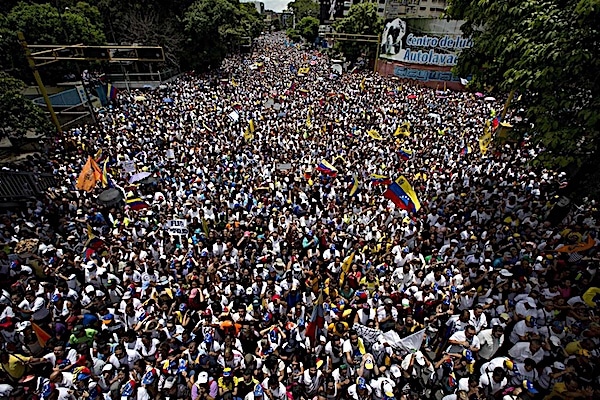
This was the straw that broke the camel's back.  Marches against the law numbering in the tens of thousands began happening in large cities and small towns all over the country, stunning local law enforcement and elected officials.  Every week starting in mid-March seemed to bring news of another march, another demonstration, each larger than the last one.  By April, Democratic party politicians (with the help of the union bureaucrats and liberal lobbying groups that organized the marches) tried to put themselves at the head of movement and shape its demands.  They tried to channel the movement behind the demand for "comprehensive immigration reform," code words for combining elements of Sensenbrenner with a guest-worker program and/or the possibility of citizenship for a very small percentage of the undocumented.

Fortunately, they failed to tame or divert the movement.  The incredible speed at which the movement arose and moved from strength to strength emboldened the immigrants who, only weeks or days before, lived in fear of being pulled over by cops and asked for their papers.  The mass radicalization developed a momentum that no Hillary Clinton could stop and culminated in the first mass political strike since the 1880s on May 1, 2006 on International Workers Day a.k.a. May Day.  The main demand was for amnesty, or complete legalization.  The demonstrations (total turnout was about 1.5 million!) were a glimpse of revolution, which Lenin described as a "festival of the oppressed," complete with banners and music celebrating the culture of almost every country in Latin America.

Despite the tremendous upsurge, the movement seemed to disappear after May 1.  HR-4437 died in the Senate, which was a tremendous victory, but it removed the movement's incentive to fight and at the same time the immigrants who made up the movement's backbone were not organized enough to sustain their activism and take the offensive.  Most of the organizations that called the marches in the spring stood aside from May 1 because it was "too radical" -- too radical for the corporate Democratic Party to co-opt.  With Sensenbrenner off the table, these groups went back to their normal, non-threatening, and meaningless activity: stumping for votes in the November election.  There was no alternative political organization in the immigrant community with the necessary size or influence to lead things in a different direction and thus passivity prevailed.

The ruling class, however, exploited the lull in struggle to go on the offensive.  In the wake of the demonstrations, 20,000 were deported last year. The Department of Homeland Security (DHS) recently announced new harsh punitive rules governing immigration which mirror much of the legislation that failed to get through Congress.  What the ruling class were unable to do through their legislature they will try to do through their executive.

The government has begun issuing no-match letters to employers notifying them of discrepancies between its records and employees' social security numbers.  Employers will be fined $11,000 and face jail time if they do not fire workers without valid SSNs within 90 days of receiving no-match letters.  Lobbyists from the agriculture and construction industries are already howling, complaining that they could easily lose millions of dollars a year because they won't have enough labor if they fire everyone who is not in the U.S. legally.  For example, it's estimated that the undocumented make up 70 percent of the agriculture industry's workforce and in California the proportion is estimated to be 90 percent.  A whopping 75 percent of undocumented workers are working with false SSNs, so these new rules have the potential to ruin the lives of millions.

The terrain on which the immigration war is being fought varies tremendously state to state, county to county, and even workplace to workplace.  State and local governments have taken it upon themselves to pass and enforce immigration laws on their own, passing 171 bills in 41 states.  For example, in New Haven, CT undocumented workers can get state-issued ID cards.  Hazleton, PA passed a law that made it illegal to hire or rent to the undocumented (which was later struck down in federal court).

The new DHS rules shift the balance of forces decisively against the undocumented.  Racist vigilante groups like the Minutemen will become stronger with the Feds blowing wind into their sales.  The Border Patrol shot a smuggler dead last week, and more incidents like this are sure to follow.  Immigrants and those that employ them will be facing a lot of heat from the DHS and local law enforcement.

The overall impact of these new rules will not be the deportation of hundreds of thousands or millions of immigrants en masse.  Instead, thousands or perhaps tens of thousands will be rounded up and deported.  The rest (including families who have been forcibly split up since many undocumented families have citizen children born here) will toil in even more oppressive conditions than before since they will be totally off the books and at the mercy of their bosses, some of whom will claim they are doing them "a favor" by employing them despite the new draconian rules.

Despite this setback, all is not lost.  It's important to remember that the struggle that exploded in spring of last year began as a defensive reaction to the leave-no-immigrant-behind Sensenbrenner bill.  Faced with a significant escalation in deportations, the destruction of whole families, and the devastation of many communities, the undocumented and their allies will fight back, not because they want to, but because they have to.

Many of the same forces that mobilized to defeat Sensenbrenner, including sections of big business, liberal lobbying groups, and union bureaucrats, will fight (within limits) the new DHS rules.  The more left-wing, grassroots community groups continued to organize despite the desertion of the right wing of the movement from the battlefield during the mid-term elections, and their cause will be strengthened by the return of the more "mainstream" groups to the arena.

It took ten long, hard years for the Civil Rights movement, starting with the Montgomery bus boycott sparked by Rosa Parks' sit-in in 1955 and ending with the Civil Rights Act and Voting Rights Act, to achieve victory.  In between the start and the "end" of the movement, there were ups and downs in activity, major arguments over strategy, tactics, direction, and militancy, tremendous victories, painful defeats, and violence by right-wing vigilantes and the state against the movement and its leaders.

Our movement today will be no different.


Pham Binh is an activist and recent graduate of CUNY Hunter.  His articles have been published at CounterPunch, Asia Times Online, and ZNet.  His blog is prisonerofstarvation.blogspot.com and he can be reached at anita_job@yahoo.com.
| | Print
MR