
Robert Cassanello, Melanie Shell-Weiss, eds. Florida’s Working-Class Past: Current Perspectives on Labor, Race, and Gender from Spanish Florida to the New Immigration. Working in the Americas Series. Gainesville: University Press of Florida, 2008. 320 pp. $69.95 (cloth), ISBN 978-0-8130-3283-2.
Once upon a time, but within this reviewer’s scholarly lifetime, the primary focus of labor history was the labor union and labor law, and how both came to be. Later, labor historians produced very thick descriptions of working-class communities, developing studies of the interaction of culture and work, often limited to one place and time. Throughout these developments, labor and other historians have supported and maintained labor’s place as a “fundamental part of the human experience” (p. 1).
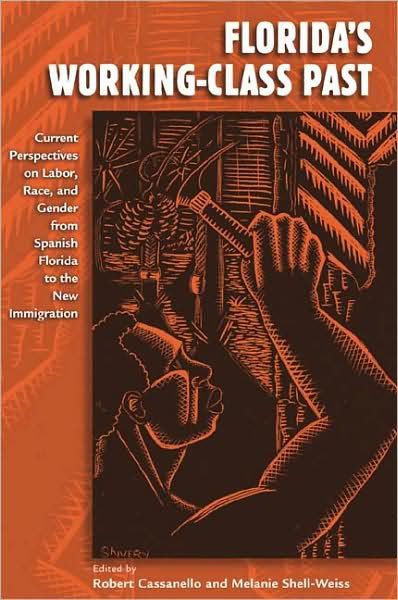 Florida’s Working-Class Past takes a broader approach. It is intended as the first in a series of volumes addressing the geographically, chronologically, and thematically broad topic of working in the Americas. The range of essays in this book demonstrates that Florida, a place born diverse and international, makes an appropriate base line for such a series. There are nine separate essays, including one each by the volume’s editors, with an introduction and epilogue coauthored by the editors. The seven contributing scholars and the two editors have all published extensively on their topics, as the helpful note to the introduction makes clear (pp. 15-16n36). The essays range from the Spanish era, starting in the 1500s, through the Justice for Janitors strike at the University of Miami in 2006. Most of Florida’s geographic breadth is included, and the diversity of its people in culture, language, race, and gender is a fundamental theme of the contributions. While the editors write that they do not intend a “comprehensive” study, the “sampling” of scholarship they do provide demonstrates how enormous an effort such a study would be (p. 11).
Tamara Spike‘s lead-off essay, “St. Augustine’s Stomach,” details the fascinating relationship between the Spanish garrison and the surrounding indigenous peoples. The garrison was almost totally dependent on its neighbors for food, but was able to coerce their service through a “tribute labor system” derived and adapted from precontact culture (p. 18).
In the second essay, Edward E. Baptist appropriates Peter Wood’s term “slave labor camp” to revise conventional descriptions of “plantations” as the locale for the coerced labor of enslaved persons in antebellum Florida (p. 31). Baptist contends that Florida’s slavery system “deployed new kinds of force and restraint, extracted greater and greater speeds of labor, and developed new institutions for converting human reproduction into wealth” (p. 32). This is a horrific and sobering story.
The volume next directs the reader’s attention to the Black Seminoles of Florida in the third essay by Brent R. Weisman. In Weisman’s view, “the relationship between blacks and Seminoles . . . was largely cemented” by 1790, and represented an amalgam of Creek, Spanish, American, and earlier indigenous Floridian structures of labor and control (p. 70). Weisman describes this complex relationship as “something that looked and felt like freedom” (p. 75). Consequently, Black Seminoles were regarded by slaveholding American whites as “apparently free former slaves” who, by their existence, caused “fear and terror” (p. 75). This fear led to the Second Seminole War and at the end, “the estimated five hundred or so Black Seminoles were gone from Florida, either dead or deported to Indian Territory” (p. 81).
The fourth essay by Mark Howard Long describes the “labor intensive agricultural system” that characterized the citrus areas of Central Florida after the American Civil War (p. 88). This system depended on a supply, even an oversupply, of reliable, contracted labor. Since neither native white nor black freedmen would accept the constraints of gang labor under long-term contract, some citrus entrepreneurs sought to employ indentured immigrants. The essay depicts the changing nature of employment contracts as both entrepreneurs and workers struggled over the terms of work.
Robert Cassanello’s essay, the fifth, brings the story of labor in Florida into the twentieth century and dissects the ways in which race and gender affected the efforts of Florida workers to organize themselves into unions. In Cassanello’s view, “For these (white, male) workers, a true man, unlike women or children, controlled his own time and body,” and collective bargaining through a union was the way to protect that “manhood” (p. 115).
Race relations become the cutting issue in Thomas Castillo‘s essay about black chauffeurs in 1915-19 Miami. In 1920, blacks made up 31 percent of Miami’s population, and 52 percent of them were from the Bahamas. In a complex story — describing the roles of white unionized chauffeurs, black independent drivers, white officials, white business elites, and the black leadership’s devotion to a racial uplift ideology — Castillo shows that class mattered as much as racial lines.
The seventh essay, by Alex Lichtenstein, details the efforts of Communist organizers to “nudge the flimsily constructed New Deal social democracy in a leftward direction” (p. 169). In Lichtenstein’s telling, this effort was far more successful during World War II than it had been during the Great Depression.
Cindy Hahamovitch next explores the anomaly of policies encouraging the migration of agricultural workers during the first half of the twentieth century when the general policy trend was to restrict immigration. At least in part, this policy deviation was allowed because the agricultural workers were not true “immigrants,” but temporary “guest workers,” brought to the United States under the control of the national government acting as a “padrone or crew leader” (p. 199).
The last essay by Melanie Shell-Weiss reaches out from Florida to tell the story of the efforts of the International Ladies Garment Workers Union (ILGWU) to organize workers in Florida and Puerto Rico. Within Shell-Weiss’s larger story is the fascinating tale of Robert Gladnick, an anti-Communist man of the Left, who sought to meet the mid-twentieth-century challenges to worker organizing of “highly mobile capital and a highly mobile workforce” (p. 241).
In the epilogue, Cassanello and Shell-Weiss conclude the volume with a “structured review of how the labor movement has diversified its approach and adapted to the ever-changing set of challenges that workers encounter today” (p. 257). The authors detail the efforts of the Coalition of Immokalee Workers (CIW), Change to Win, and Justice for Janitors to extend the labor struggle into the communities where the contests take place.
While Florida’s Working-Class Past does not “fully capture the experience of (Florida’s) working people,” that is not the intent of this volume (p. 270). Each essay would make an excellent assigned reading for an appropriate topic in a course in Florida history. Each essay points to further scholarly research, both in Florida history and labor history. This reviewer was left with a provocative question at the end of each contribution. The editors’ stated goal of presenting a “sampling” has been met.
The introduction and especially its note on labor historiography will help situate the essays for historians of Florida with less knowledge of American labor history. However, there is little to help labor historians less familiar with Florida history. For them, it might have been useful to link the essays with well-known surveys of Florida’s political, social, and cultural history. Michael Gannon’s Florida: A Short History (2003); Alex Stepick, Guillermo Grenier, Max Castro, and Marvin Dunn’s This Land Is Our Land: Immigrants and Power in Miami (2003); and Gary Mormino’s Land of Sunshine, State of Dreams: A Social History of Modern Florida (2005) come to mind. While the lack of maps, photographs, and illustrations in Florida’s Working-Class Past may not be the failure of the editors, any reader, but especially a classroom teacher, would do well to have a map of Florida and the Caribbean at hand when using this volume. The Florida Memory project’s visual and audio materials may also be helpful in making classroom presentations based on the essays.1
Note
1 Florida Memory, State Library and Archives of Florida, www.floridamemory.com.
Jeff Donnelly holds a doctorate in American Studies from New York University. He is the director of the Art Deco Academy and Tour School sponsored by the Miami Design Preservation League. This review was first published by H-Florida (July 2009) under a Creative Commons license.