
John Bellamy Foster and Fred Magdoff, The Great Financial Crisis (Monthly Review Press, 2009).
One of the few boom industries in times of slump, it seems — aside from private security firms, debt collection agencies and porn — is the publication of books about slumps.
Everyone from Vince Cable to Newsnight economics editor Paul Mason is touring the country, touting their own take on recent economic events. Copies of Das Kapital are reportedly flying off the shelves faster than they can be printed.
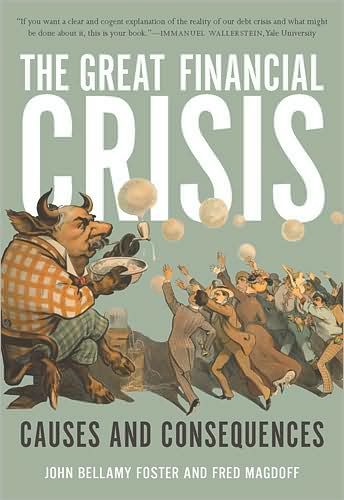 What makes this short book by the editors of the long-standing US left journal Monthly Review stand out is that it looks beyond the shenanigans of high finance to the deeper, structural causes of capitalism’s current malaise.
Fifty years ago, Paul Baran and Paul Sweezy published their classic work Monopoly Capital.
In it, they argued that mainstream economic thinking on recession was topsy-turvy from the outset.
Instead of asking why the Great Depression occurred — and thus accepting that it was some kind of freak occurrence — they argued it was capitalism’s growth periods that needed explaining.
Capitalism in its monopoly phase — the age of the giant corporation — is characterised by stagnation and only experiences anything different due to historically specific — and temporary — “fixes.”
At the root of this stagnation lies the classic contradiction of capitalism — that productive capacity tends to outstrip effective demand.
In other words, we are not paid enough to buy all the crap we produce. Goods pile up unsold, productive activity freezes up and capital is unable to find avenues for profitable reinvestment.
The second world war provided the ultimate “fix” to this problem — wiping out large amounts of capital, laying the ground for a new round of investment. By the 1970s, however, the system had reverted to its natural state of stagnation.
Foster and Magdoff’s argument is that, since then, the main fix has been the financialisation of the economy.
Denied profitable investment opportunities in the “real economy” of production, capital has instead flowed into finance or a series of increasingly volatile and overinflated asset price bubbles — most recently, real estate.
For a time, this was a double boon for capital — not only did mortgage lending provide an outlet for surplus profits, but rising equity on houses allowed people to take out huge loans.
These loans became the driving force behind rising consumption in the US economy, since real wages have been in decline for more than three decades.
Credit became the new fix to the classic problem — if people cannot afford to buy all the crap they produce, they can be lent the money to do so.
It was clearly a “solution” built on seriously fragile foundations.
What made Baran and Sweezy’s “stagnation thesis” radical in the 1960s was that capitalism was still in the midst of a “golden age” of unprecedented growth and therefore did not look stagnant.
Today, however, reality confirms its validity everywhere you look.
The challenge for the left is to articulate both the temporary nature of capitalism’s fixes and of capitalism itself in accessible terms.
This book is a useful weapon for all who strive to do so.
This review was first published by the Morning Star on 11 August 2009; it is reproduced here for fair-use educational purpose.