
Eduardo Galeano, Open Veins of Latin America: Five Centuries of the Pillage of a Continent, 25th anniversary edition (New York: Monthly Review Press, 1997).
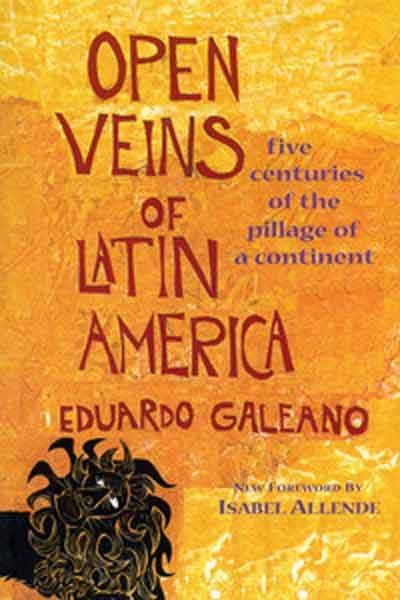 As Editorial Director of Monthly Review Press, I was delighted to learn that Venezuelan president Hugo Chavez gave his U.S. counterpart Barack Obama a copy of Eduardo Galeano’s Open Veins of Latin America. Within two days, the book shot to number two on Amazon, and copies were sailing out of our warehouse, improving our cash flow.
But there was a more fundamental reason for my delight. I began teaching a course titled “The Political Economy of Latin America” in the early 1970s. My take on the world was Marxist, and Latin America provided ample evidence that Marx’s analysis of capitalism was right on the mark. The problem was finding textbooks sophisticated enough to explain the complexities of a region with so many nations, but simple, clear, and exciting enough to resonate with and inspire my provincial students. For the more rigorous economic analysis, I chose Celso Furtado’s excellent book, Economic Development of Latin America. If I had used this alone, the course would have been a disaster, no matter how well I explained the details of Furtado’s thesis that there were profound structural barriers to Latin America’s economic development. Fortunately, the Monthly Review Press catalogue contained a book that seemed tailor-made for the class, Open Veins of Latin America: Five Centuries of the Pillage of a Continent. I ordered it, read it nearly straight through, placed a class order at the college bookstore, and breathed a sigh of relief.
There is no doubt that Galeano’s book is a classic, the best introduction to the history of Latin America after Columbus ever written. What makes it so brilliant is that it is not a traditional history but, as Galeano put it, a “conversation” with the people. It combines facts and analysis with explosive and beautiful writing to produce both a cry of the heart and a call to arms. This book never failed to elicit strong responses from students, every emotion from astonishment and anger to disbelief and hatred (of me, for having the audacity to suggest that the United States had almost always behaved violently and criminally in Latin America).
Open Veins is organized around a series of stories, each demonstrating a central truth about Latin America. The Europeans came, saw, and conquered the indigenous peoples. They murdered them, enslaved them, gave them fatal diseases, and stole their wealth. When the original inhabitants died — some choosing to do so by their own hands rather than continue lives of degradation — the Spaniards, Portuguese, Dutch, and English brought slaves from Africa to take their places in mines and plantations. The European conquest resulted in historically unprecedented reductions in population, numbers not recovered until hundreds of years later, if at all. First, there was silver, mercury, and gold; then sugar, tobacco, coffee, cotton, tin, nitrates, bananas, and oil. All of these things fueled capitalism in Europe, indeed made it possible. Wealth flowed to Europe like blood from open veins.
The obverse of Europe’s development was Latin America’s underdevelopment; the one was the cause of the other. Potosí, the fabulous city of silver in Bolivia, was, by the mid-seventeenth century, one of the world’s largest cities, with metal-bedecked cathedrals and streets made of silver. Silver went from the rich hills to Spain, from whence most of it traveled to England to pay for Spanish debts. A few got rich, including the locals who did their European masters’ dirty work. But the silver mines and the mercury production necessary to extract silver from the rocks were dreadfully deadly to the workers, who died by the thousands. Then, when the mines gave out, the city went to ruin, and the many sank into a listless misery — a process that, with variations, repeated itself over the centuries in every country. When the heart pumped out its last blood through the venas abiertas, all that remained was a desiccated corpse. Galeano says that, “The division of labor among nations is that some specialize in winning and others in losing. Our part of the world, known today as Latin America, was precocious: it has specialized in losing ever since those remote times when Renaissance Europeans ventured across the ocean and buried their teeth in the throats of the Indian civilizations.” The winners said that the losers were inferior and deserved their fate, while they were superior and got their just deserts as well. Economists say the same thing today.
Political independence by no means stopped the bleeding. New mechanisms of exploitation replaced the old, and the United States supplanted England as the dominant imperial power. But unequal exchange, financial dependence, the industrial and technical monopolies of the U.S. oligopolies, and the International Monetary Fund yielded the same result. Latin America gave and the rich countries took. When trouble reared its head, that is, when the workers and peasants demanded their due or when a populist government tried to restrain capital’s rapaciousness and develop internal markets and diverse economies, military force was ready at hand, local if possible and foreign if need be. Galeano provides a fascinating account of Paraguay, which at the beginning of the nineteenth century was the only South American country independent of Europe. Under the guidance of autocratic nationalist leaders, Paraguay had built a strong and diversified economy and had little of the poverty so common among its neighbors. Such a bold autonomy was intolerable to England, so it engineered a war on Paraguay by Argentina, Brazil, and Uruguay. This bloodiest war in South American history left Paraguay ravaged and poor, and its effects linger to this day. Paraguay’s early leaders were denounced as bloodthirsty dictators, a view still held by modern historians. It is important that lessons useful to the poor be obliterated, and so they were. And are today.
Some critics have argued that Galeano’s view is overly pessimistic; Latin America’s losing streak never ends. But this is not true. He is encouraged by revolts, wherever and whenever they have occurred. Indians rebelled, slaves revolted, peasants took back their land, workers struck, revolutionaries took to the mountains and jungles. Like Túpac Amaru, most were defeated. Their resistance lived on in the popular imagination, however, waiting for some propitious moment to take wing in the actions of others. The Cuban revolution, for example, has sustained itself against all odds, a shining light for all those who hunger for liberation.
Galeano reminds us that “The ghosts of all the revolutions that have been strangled or betrayed through Latin America’s tortured history emerge in the new experiments, as if the present had been foreseen and begotten by the contradictions of the past. History is a prophet who looks back: because of what was, and against what was, it announces what will be.” Maybe Hugo Chávez, so much the embodiment of what we socialists hope will be, was thinking of this passage when he gave Barack Obama this most appropriate gift.
Michael D. Yates, Editorial Director of Monthly Review Press, Associate Editor of Monthly Review. This review also appears in the Green Left Weekly.