
. . . The travails of the lands of Ire and Ice are not so much at odds with each other and come down essentially to the same point — the size of banking assets to that of the general economy; but they do differ considerably in how the two economies approached the battle. . . .
Ireland adopted the “way of the fire”, namely to show massive irritation with the conduct of its bankers, but nevertheless stopped to bail them out and imposed austerity measures on the rest of the economy. Iceland on the other hand adopted the tactic of “freezing out” bank creditors, and in so doing may well have put itself on a quicker path to economic recovery. So how did the two opposing strategies work out?
The graph of Ireland vs Iceland in credit default swap markets, derived from Bloomberg, and shown below, highlights a moderate blowup for the Icelandic sovereign early in the year when there was some expectation of a new bank bailout; once this was denied, the sovereign tightened through the course of the next few months.
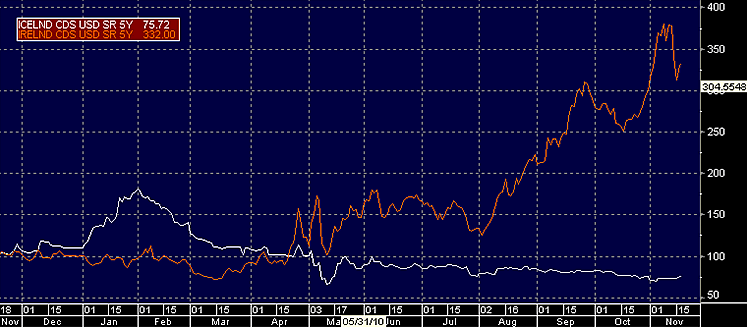
In contrast, Ireland chose to save its banking system by essentially guaranteeing all deposits and also bailing out private creditors who owned the senior and subordinated debt of the Irish banks. That wasn’t enough though — Irish banks saw a steady worsening of their funding ratios over the past few months and finally had to resort to extreme reliance on the European Central Bank (ECB).
This in turn became a mark of no-confidence in the markets and very slowly investors came to the realization that if the ECB altered its lending criterion in any way, Irish banks would have to depend exclusively on the government.
The Irish government embarked on a severe austerity program in the past few months, and . . . it is among the few Western sovereigns to expect a significant decline in debt issuance next year.
Its own borrowing program, totaling around 28 billion euros (US$38 billion) for 2011, is largely in place. That isn’t, however, the key problem that the markets are fretting about — rather it is the fact that borrowings for banks in the order of 80 billion euros or so would need to be coughed up by the Irish government. This is the unsustainable part of the equation and one that Ireland can blame not so much on itself but rather on the very construct of the European Union. . . .
. . . [T]he common currency is a safety value but is also a pressure cooker. Inside the cooker, Ireland wasn’t allowed to let its banks fail while protecting depositors; instead, to avoid the spread of financial system risk across Europe, Ireland was forced to save its banks.
In contrast, Iceland had no such constraints and allowed its banks — whose assets over gross domestic product exceeded even Ireland’s — to go under. In so doing, the Icelandic government effectively forced the losses on Icelandic borrowing to be borne by German and French banks. As banks shed their total debt and separated into “good” and “bad” bank entities, normal banking activities resumed in Iceland. While the economy has become smaller and asset values (measured in euros) have plummeted, there is a chance of stronger economic recovery in coming years driven by fishing, tourism and aluminum (the traditional businesses of Iceland). . . .
The text above is an excerpt from Chan Akya, “(F)Ire and Ice” (Asia Times, 20 November 2010); it is reproduced here for non-profit educational purposes. Cf.:
| Ireland | Iceland |
| Tracy Alloway, “Who’s Bailing Out Whom?” (FT Alphaville, 18 November 2010); Tracy Alloway, “Anglo Irish Bondholders Blink” (FT Alphaville, 19 November 2010); Tracy Alloway, “(Allied) Irish Banking Understatement” (FT Alphaville, 19 November 2010); “[Irish Finance Minister] Mr [Brian] Lenihan and the Fianna Fáil-led coalition government of Brian Cowen, prime minister, on Friday looked set to capitulate, bullied into a bail-out” (David Gardner, Tony Barber, and Peter Spiegel, “Ireland: A Punt Too Far,” Financial Times, 19 November 2010); “Ministers will meet on Sunday to complete the plan, which will involve at least €15bn ($20bn) of spending cuts and tax increases — or about 10 per cent of annual economic output — from 2011 to 2014” (Tony Barber and John Murray Brown, “Ireland Bail-out Talks Intensify” Financial Times, 19 November 2010). | “The draft accord [on the Icesave deposits] reached carries a 3 percent interest rate and gives Iceland’s government a nine-month moratorium on paying interest, the country’s Channel 2 television station said on Nov. 15. The Finance Ministry declined to comment on the details of any talks. The accord will cost the government 40 billion kronur ($355 million) to 60 billion kronur, the broadcaster said. The remainder would be covered by the value of Landsbanki assets” (Omar R. Valdimarsson, “Iceland Closer to U.K., Dutch Depositor Deal That May Spark Rating Upgrade,” Bloomberg, 17 November 2010); “Foreign creditors look likely to recover little or nothing from Landsbanki after the Icesave debt has been repaid, leading some to threaten a court challenge” (Andrew Ward, “Agreement Near on New Icesave Deal,” Financial Times, 16 November 2010); “Iceland’s government may announce its decision on how it will relief household debt as early as next week, Finance Minister Steingrimur J. Sigfusson said in a radio interview. . . . Iceland may limit debts to 110 percent of property values or a step-by-step reduction of obligations to 90 percent of asset values, according to Nov. 10 proposals by a panel with representatives from the government, opposition, pension funds and banks. The government could also take over non-performing debt from lenders, excluding the state-backed Housing Financing Fund, and then reduce debts through arbitration” (Omar R. Valdimarsson, “Iceland May Present Debt Relief Plan Next Week, Sigfusson Says,” Bloomberg, 19 November 2010). |
| Print