
We have argued for some time that the policy debate about Iran here in the United States is distorted by a number of “myths” — myths about the Islamic Republic, its foreign policy, and its domestic politics. One of the more dangerous myths currently affecting America’s Iran debate is the proposition that, through concerted diplomatic action, the United States can isolate the Islamic Republic, both regionally and internationally.
The proposition that the Islamic Republic can be isolated within its regional environment rests on an unchallenged but deeply flawed assumption that, given its “Persian” (or at least non-Arab) and Shi’a identities, Iran is bound to be viewed with suspicion, if not hostility, by the Middle East’s (largely Sunni) Arab population. This proposition also rests on an assumption that the United States can play on anti-Iranian suspicion and hostility to isolate the Islamic Republic from its regional neighbors.
The idea that Washington has a serious and strategically productive option to isolate Iran in its region is, of course, not new — it is reflected in efforts by the Clinton, George W. Bush, and Obama administrations to forge a regional coalition to “contain” Iran, encompassing “moderate” Sunni Arab states along with Israel. But this notion has gained greater traction recently, alongside claims of “rumblings” — to use President Obama’s word — that new sanctions are beginning to stimulate domestic political pressure on Iranian leaders. Just last month, the usually quite sound Marc Lynch argued that
[O]verall Tehran has become considerably weaker in the Middle East under Obama’s watch. Much of the air has gone out of Iran’s claim to head a broad “resistance” camp, with Obama’s Cairo outreach temporarily shifting the regional debate and then with Turkey emerging as a much more attractive leader of that trend. The botched Iranian election badly harmed Tehran’s image among those Arabs who prioritize democratic reforms, and has produced a flood of highly critical scrutiny of Iran across the Arab media. Arab leaders continue to be suspicious and hostile towards Iran. . . . Public opinion surveys and Arab media commentary alike now reveal little sympathy for the Iranian regime, compared to previous years . . . while Iran may continue to doggedly pursue its nuclear program (as far as we know), this has not translated into steadily increasing popular appeal or regional power. Quite the contrary.
There is no specific sourcing for any of the claims made in this passage. However, a number of commentators arguing that Iran is becoming increasingly unpopular in its regional environment drew support from this year’s iteration of the Pew Research Center’s Global Attitudes Project, released in June and based on polls conducted in 22 countries around the world during April and May. In the six Muslim-majority countries included in the Project (Egypt, Indonesia, Jordan, Lebanon, Pakistan, and Turkey) a majority of the population in four (Egypt, Jordan, Lebanon, and Turkey) reportedly had an “unfavorable” view of Iran; only in two of the Muslim-majority countries surveyed (Indonesia and Pakistan) did a majority of the population have a “favorable” view of Iran. Likewise, majorities in five of the six Muslim-majority countries reportedly viewed Iran’s nuclear program as a potential threat; only in Pakistan was the Iranian nuclear program and the prospect of an “Iranian bomb” (which, of course, the Iranian government denies it is seeking) viewed favorably.
We had doubts at the time about some of the results in the Pew survey. For example, with regard to a majority of Lebanese reportedly having an “unfavorable” view of Iran — if one broke down the Lebanese numbers according to sectarian identity, a majority of Lebanese Muslims had a favorable view of Iran, while 83 percent of Lebanese Christians had an unfavorable view. Demographics alone mean that the overwhelming majority of those Lebanese Christians holding an unfavorable view of Iran are Maronite. It seems highly likely that the Pew pollsters over-weighted Maronite Christians in their Lebanese sample. (Of course, “over-weighting” Maronites is something that the Lebanese political system has been doing for decades, with sustained support from the United States and Europe.) Likewise, the data showed appreciable support for Iran’s nuclear program in some Arab populations where one might not have expected to see that — e.g., roughly 40 percent of Jordanians supported Iran’s nuclear program, even though Jordanians have been exposed to a steady stream of criticism of Iran’s nuclear efforts from the Jordanian government.
But now an important poll has come out raising real questions about what the Pew survey was measuring — and, more importantly, raising profound questions about the argument that Iran is becoming isolated in its regional environment. Last week, Shibley Telhami released the results of his 2010 Arab Public Opinion Poll, which he conducts annually with Zogby International. Over the years, we have found Shibley’s polling studies on Arab public opinion to be carefully conducted, with scrupulously presented results and, often, important insights. We would also note that Shibley — who holds the Anwar Sadat Chair at the University of Maryland and is a non-resident fellow at the Saban Center for Middle East Policy at the Brookings Institution — can hardly be dismissed as a “pro-Iranian” voice.
The results from this year’s Arab Public Opinion Poll can hardly be comforting for those who want to believe that the Islamic Republic is becoming estranged from its regional neighbors and that Arabs are ready to stand side-by-side with Israelis to support military action (by Israel and/or the United States) against Iranian nuclear targets. The poll was conducted in late June and July in Egypt, Jordan, Lebanon — these countries were also included in the Pew Research Center’s Global Attitudes Project — Morocco, Saudi Arabia, and the United Arab Emirates. With regard to the Iranian nuclear issue:
- Among the respondents, a majority — 57 percent — believes that Iran’s nuclear program is aimed at developing nuclear weapons (which, once again, the Iranian government denies it is seeking). However, an even larger majority of these entirely Arab respondents — 77 percent — believes that Iran has the right to pursue its nuclear program; only 20 percent agree that Iran should be pressured by the international community to stop the program. (By way of comparison, the finding that 77 percent of Arabs believe that Iran has a right to pursue its nuclear program is up from 53 percent in 2009.)
- In Egypt and Morocco, huge majorities among those who believe that Iran’s nuclear program is aimed at developing nuclear weapons — 81 percent and 84 percent, respectively — believe that Iran has the right to pursue such a program. In Saudi Arabia, the population that believes Iran’s nuclear program is aimed at developing nuclear weapons is evenly divided, 50 percent to 50 percent, on this question.
-
 These data set the stage for one of the most remarkable findings in this year’s Arab Public Opinion Poll: 57 percent of the respondents believe that Iran’s acquisition of nuclear weapons would be a positive outcome for the region; 20 percent believe this would not matter one way or the other, while only 21 percent believes this would be a negative outcome for the region. (By way of comparison, the finding that 57 percent of Arabs believe that Iran’s acquisition of nuclear weapons would be a positive outcome for the region is up from 29 percent last year.)
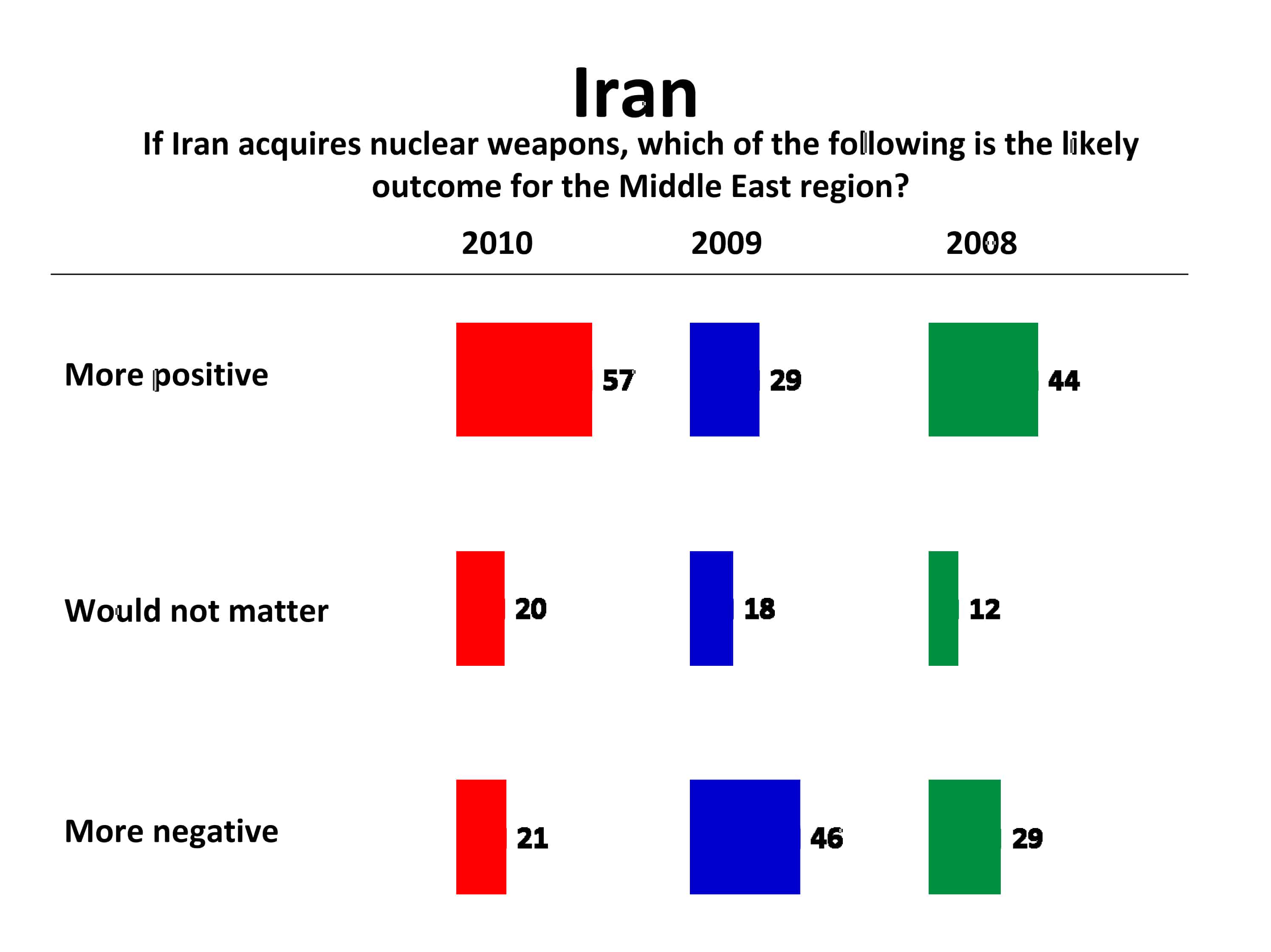
This is truly remarkable. In six Arab countries where the ruling authorities have devoted a lot of effort in recent years telling their people that the Islamic Republic aspires to regional hegemony and is seeking nuclear weapons, and that this would be a bad outcome for Arab interests, local Arab populations are not buying the argument. Even Marc Lynch had to acknowledge that “there is very little support here for the notion that Arabs are secretly yearning for the United States to attack Iran. Really little.” This bolsters our assessment that, however much some Sunni Arab elites — and we suspect it is not all that many — may want to see Iran “cut down to size,” there is little popular support for confrontation with the Islamic Republic on the Arab street.
In fact, with regard to the Iranian nuclear issue and perceptions of the Islamic Republic as a “threat”, the trend in Arab public opinion over time is running in the opposite direction from that desired by most major Arab governments. (We wonder what public opinion is like on these questions in Syria? In Iraq? In Qatar? Or among Gazans and other Palestinians living under Israeli occupation?) Asked to name the two countries in the world that pose the biggest threat, 88 percent of the Arab respondents in Shibley’s 2010 poll named Israel and 77 percent named the United States — the top two “winners” on this question, by orders of magnitude over any other country. By way of comparison, only 10 percent of respondents cited Iran as one of the two countries in the world posing the biggest threat. (That is down from 13 percent last year. This year, incidentally, the same percentage of respondents that viewed Iran as a threat — 10 percent — also cited Algeria as a threat.)
And, for those who claim that, as Marc Lynch put it, there is now “little sympathy for the Iranian regime, compared to previous years,” we would challenge them to explain these findings:
- Asked to name the world leader that they admire most, 12 percent of the Arab respondents in Shibley’s poll cited Iranian President Mahmoud Ahmadinejad. This is up from six percent last year.
- That 12 percent result makes Ahmadinejad the third-most admired leader in the Arab world — after Turkish Prime Minister Recep Tayyip Erdoğan (with 20 percent) and Venezuelan President Hugo Chavez (with 13 percent). In 2009, according to the Arab Public Opinion Poll, Ahmadinejad was tied with Hizballah secretary-general Sayyid Hassan Nasrallah and Al-Qa’ida leader Usama bin Laden as the fourth-most admired leader among Arabs, after Chavez, Syrian President Bashar al-Assad, and former French President Jacques Chirac. In 2008, Ahmadinejad was the third-most admired leader in the Arab world, after Chavez and Assad.
Where is the enormous decline in Ahmadinejad’s popular standing in the Arab world? Where is the sharp deterioration in the Islamic Republic’s image in the Arab world?
If Americans want to find a big “loser” in this year’s Arab Public Opinion Poll, the results identify him quite clearly — President Barack Obama.
- According to Shibley’s data, the percentage of Arabs with a positive view of the United States has plummeted since last year — from 45 percent to 20 percent — while the percentage with a negative view of the United States has soared from 23 percent to 67 percent.
- Last year, 51 percent of Shibley’s respondents were “hopeful” about the Obama Administration’s Middle East policy; this year, only 16 percent are hopeful, while 63 percent describe themselves as “discouraged.” Interestingly, in a separate question, 51 percent of respondents said that they had an unfavorable view of Obama and were pessimistic about his foreign policy; 38 percent said they had a favorable view of Obama personally but doubted that “the American system would allow him to have a successful foreign policy.”
- Perhaps most strikingly, only two percent of this year’s respondents described themselves as holding a “very favorable” attitude toward the United States; this is down from the four percent that had a “very favorable” attitude toward the United States in 2008 — the last year of George W. Bush’s presidency.
With those numbers, it is truly surreal for the Obama Administration and its supporters — or neoconservative commentators — to be extolling how badly isolated the Islamic Republic of Iran is becoming in the broader Middle East.
Flynt Leverett directs the Iran Project at the New America Foundation, where he is also a Senior Research Fellow. Additionally, he teaches at Pennsylvania State University’s School of International Affairs. Hillary Mann Leverett is CEO of Strategic Energy and Global Analysis (STRATEGA), a political risk consultancy. In September 2010, she will also take up an appointment as Senior Lecturer and Senior Research Fellow at Yale University’s Jackson Institute for Global Affairs. The text above is an excerpt from an article first published in The Race for Iran on 8 August 2010 under a Creative Commons license.
| Print