
“The peace movement, sexist as it was, expressed disenchantment with violence, super-technology and imperialism.” — Adrienne Rich, Of Woman Born; Motherhood as Experience and Institution
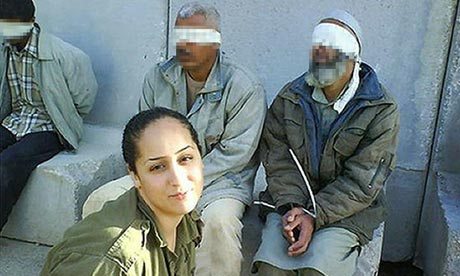 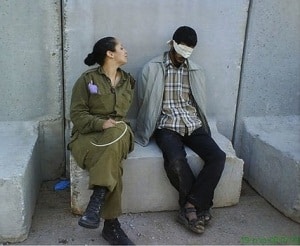 |
Pictures of former Israeli soldier Eden Abargil posing in front of blindfolded and handcuffed Palestinian prisoners have caused some controversies in the media. Abargil did not think she had done anything wrong by posting her photos to her Facebook site; she was genuinely surprised by the “fuss” over the photos. Clearly her indifference is a cultural product of military rule over occupied territories, the colonial mentality that arises from subjugation of a displaced and dispossessed people. It is the de-humanization of the victims of colonial force. Yishai Menuchim of the Israeli Committee Against Torture said, “this reflects an attitude which has become the norm and consists in treating the Palestinians like objects, not human beings.”
Abargil’s Facebook photos represent the banality of oppression. The transformation of oppressed into oppressor is nothing new in history, so why do we find her Facebook photos so disturbing? The same question struck me even more forcefully when I first saw Abu Ghraib pictures of women guards posing with Iraqi prisoner victims, in porno-sadistic settings used as a mechanism of domination (putting leashes on naked men prisoners and so forth).
Is it the residue of the unconscious male chauvinist in us, who clings to the outmoded cliché of women as sister-mother caregivers and nurturers? The idea of gender parity in society tells us that women should not be barred from any occupation; ultimately nothing should be exclusive to men. So, why then is the “woman as torturer” more puzzling to us than the man in the same role? After all we want women to be protagonists, not mere spectators, in social processes. Consequently, the concepts of compassion and cruelty, too, ought to be genderless.
And yet they are not: even as a certain variety of feminist ideas become part of our commonsense, the dominant culture remains pervasively gendered and sexualized. On one hand, powerlessness is coded as “feminine.” Regarding the Guantanamo photos, Arshin Adib-Moghaddam wrote in the pages of Monthly Review, citing Joseph Massad: “[T]he type of power that feminizes its object in order to violate her . . . ‘imperial military culture supermasculinizes not only its own male soldiers, but also its female soldiers who can partake in the feminisation of Iraqi men’.” On the other hand, the combination of “power” and “woman” is marketable, in so far as it can be sexualized. From Hollywood to “reality shows,” pop culture moneymakers try to sell us the sexy cruel woman predator. (The character of the Nazi woman prison guard in a concentration camp in Seven Beauties, a 1975 film by Lina Wertmuller, may be an exception.)
Besides, from the truly feminist perspective, isn’t the “woman torturer” just appropriating and internalizing the masculinist concepts which would facilitate the perpetuation of hierarchy? Simone de Beauvoir argued that “one is not born a woman; one becomes one.” Women are “the other,” the sex defined by men. Beauvoir attempted to liberate women from “objectification” by exposing the female internalization of male-gender definition of self/other, thus ending the complicity of women in the process of objectification and subverting the unequal power relations.
Take the former Israeli Prime Minister Golda Meir. Does she symbolize professional advancement and empowerment of women? Or does she represent settlements, colonization, and oppression? The neo-Marxist literary critic Terry Eagleton, writing on Irish literature (“Nationalism: Irony and Commitment”), helps us put such questions in their proper perspective: “Any emancipatory politics must begin with the specific . . . but must in the same gesture leave it behind. For the freedom in question is not the freedom to ‘be Irish’ or ‘be a woman,’ whatever that might mean, but simply the freedom now enjoyed by certain other groups to determine their identity as they may wish”; at the same time, “The feminist, nationalist, or trade unionist might now come to recognize that in the long run none of their desires is realizable without the fulfillment of the others’.” As Eagleton acknowledges Kierkegaard’s complaint, it is difficult to live the Hegelian totality. And yet without an attempt to link a particular demand (that women not be excluded from any occupation) to the general truth (of the necessity of human liberation), what began as an emancipatory politics may end up contributing to its opposite.
It is, then, not so inconceivable to expect a civil rights activist to become aware of gender issues. It is not so unfair to expect a woman entrepreneur who as a result of affirmative action policies earns government contracts to retain sensitivity towards the marginalized. And it is not so unreasonable to expect all of them to understand the Third World emancipation movements for fulfillment of self-actualization.
Farid Marjai is a contributor to the reformist newspapers of Shargh and Etemad.
| Print