
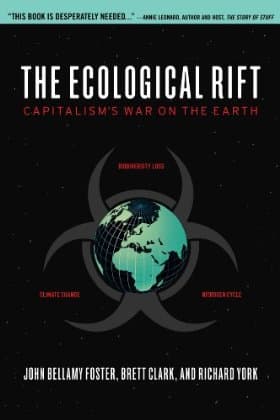
John Bellamy Foster, Brett Clark, and Richard York. The Ecological Rift: Capitalism’s War on the Earth. Monthly Review Press, 2010. 544 pages.
Climate change is often called the greatest environment threat facing humanity. The threat is very real. Unless we cut carbon pollution fast, runaway climate change will worsen existing environmental and social problems, and create new ones of its own. But it’s no longer enough to simply refer to the climate crisis. Climate change is one part of a broader ecological disaster, brought about by an economic system that relies on constant growth, endless accumulation, and ever-deepening human alienation.
A 2009 study published in Nature revealed some of the extent of this ecological crisis. The study, which was led by Sweden’s Johan Rockstrom and included US climate scientist James Hansen, identified nine “planetary boundaries” that are critical for human life on the planet. Along with climate change, these boundaries are: global freshwater use, chemical pollution, ocean acidification, land use change, biodiversity (the extinction rate), ozone levels in the stratosphere, aerosol (or small particle) levels in the atmosphere, and the nitrogen and phosphorus cycles that regulate soil fertility (and hence food production). The study said three of these critical planetary boundaries — climate, the nitrogen cycle, and biodiversity loss — had already been crossed. A further four — land use change, the phosphorus cycle, ocean acidification, and freshwater use — are emerging problems. The scientists said these boundaries had not yet been breached but could be soon if nothing was done. The state of the ozone layer, which regulates the ultraviolet radiation from the sun hitting the Earth, was the only good news. A global treaty to phase out ozone-depleting gasses, such as chlorofluorocarbons, seems to have made a difference. The study’s authors said they didn’t yet know enough to measure the planetary boundaries for chemical pollution and aerosol levels.
 |
In their 2010 book, The Ecological Rift, US Marxists John Bellamy Foster, Brett Clark, and Richard York remark on this study:
The mapping out of planetary boundaries in this way gives us a better sense of the real threat to the earth system. Although in recent years the environmental threat has come to be seen by many as simply a question of climate change, protecting the planet requires that we attend to all of these planetary boundaries, and others not yet determined.
The essential problem is the unavoidable fact that an expanding economic system is placing additional burdens on a fixed earth system to the point of planetary overload. . . . Business as usual projections point to a state in which the ecological footprint of humanity will be equivalent to the regenerative capacity of two planets by 2030.
Capitalism, a grow-or-die system, must ignore the planet’s boundaries. But we cannot afford to — not if we are to secure a safe planet that can sustain human civilisation. As Foster, Clark and York conclude: “No solution to the world’s ecological problem can be arrived at that does not take the surmounting of capitalism, as an imperialist world system, as its object. It is time to take the planet back for sustainable human development.”
The Ecological Rift deserves – and needs — to become a classic in its field. Dozens and dozens of new books, and many thousands of papers and articles, are published about the ecological crisis each year. The literature on the Earth’s growing environmental problems has become a minor growth industry in itself. But despite the scale of the crisis, surprisingly few environmentalists in the global North are challenging their own preconceptions about the present social and economic system, the causal role it plays in driving ecological decay, and the ways in which the system can be challenged, overcome, and replaced. Curtis White zoomed in on this persistent trend in a 2009 article in Orion magazine:
There is a fundamental question that environmentalists are not very good at asking, let alone answering: “Why is this, the destruction of the natural world, happening?” . . .
But as scientifically sophisticated as environmentalism’s thinking about natural systems can be (especially its ability to measure change and make predictions about the future based on those measurements), its conclusions about human involvement in environmental degradation tend to be very reductive and causal.
Environmentalism’s analyses tend to be about “sources”. Industrial sources. Nonpoint sources. Urban sources. Smokestack sources. Tailpipe sources. Even natural sources (like the soon-to-be-released methane from thawing Arctic tundra). But environmentalism is not very good at asking, “Okay, but why do we have all of these polluting sources?”
The Ecological Rift is an exception to this norm. Its starting point is a frank assessment of the problems, but it focuses on a sustained critique of the mainstream ecological theories, solutions, and proposals that do not address the root cause of the dilemma and that do not deeply investigate why the ecological crisis has reached such dire proportions.
A big issue for those concerned with climate change and other environmental ills is to get a better understanding of the capitalist system, who benefits most from it, and how it works to undermine stable ecosystems. The authors describe capitalism as a system of rifts and shifts. Rifts, because its reliance on short-term profit and endless growth means it must drive an ever-deepening wedge between human society and the natural conditions needed to sustain all life. Shifts, because when it’s confronted with environmental degradation the system tends to simply move it elsewhere. These shifts are often geographical — toxic, polluting industries are moved out of urban areas or from the rich nations to the global South. Another example is how the depletion of natural resources in one region merely drives capital to expand its reach somewhere else in the globe. The oil industry, which has expanded offshore drilling operations in the past few decades (think the Gulf of Mexico) and now wants to drill for oil in the relatively untouched Arctic Ocean, is a classic example of this kind of geographical shifting characteristic of capitalism.
But the shifts are also technological. Capitalism has typically responded to environmental problems and resource depletion with technical changes in the methods of production: wood-burning substituted for coal-burning, natural fertiliser for synthetic fertiliser, paper for plastic, conventional oil for biofuels, and fossil fuel power plants for nuclear power plants. These changes have opened up new profitable markets but have also created new, and more pressing, ecological rifts. The authors explain:
One way to look at this is to see capitalism as a bubble economy, which uses up environmental resources and the absorptive capacity of the environment while displacing the costs back on Earth itself, this incurring an enormous ecological debt.
As long as the system is relatively small and can keep expanding outwardly, this ecological debt is displaced, often without any recognition of the costs that have been incurred. Once the economic system begins to approach not just its regional boundaries but planetary boundaries, the mounting ecological debt will become ever more precarious, threatening an ecological crash.
Yet the nearness of this crash won’t prompt the system’s rulers to change course. Environmental destruction is part of capitalism’s DNA.
Capitalism is incapable of regulating its social metabolism with nature in an environmentally sustainable manner. Its very operations violate the laws of restitution and metabolic restoration. The constant drive to renew the capital accumulation process intensifies its destructive social metabolism, imposing the needs of capital on nature, regardless of the consequences to natural systems.
Capitalism continues to play out the same failed strategy again and again. The solution to each environmental problem generates new environmental problems (and often does not curtail the old ones). One crisis follows another in an endless succession of failure, stemming from the internal contradictions of the system. If we are to solve our environmental crises, we need to go to the root of the problem: the social relations of capital itself.
Mainstream environmental commentators and groups resist this conclusion. Although they may be harshly critical of the environmental destruction, they limit their proposals to what is feasible within the framework of the capitalist system. Sometimes this is justified on pragmatic grounds that the ecological crisis is so advanced that we don’t have time to change the system, and so we need to work within the flawed system we’ve got. Others have been convinced by the neoliberal argument that capitalism can be made green and serve ecologically sensible outcomes — the idea that once environmental goods are adequately priced, preserving ecosystems can be made profitable and the market could become the saviour, rather than the destroyer, of the planet. Yet others still may acknowledge capitalism’s anti-ecological features, but are either pessimistic about the potential to change society or think that any other social system would be even worse.
But Foster, Clark, and York argue that these outlooks actually serve to play down the gravity of the crisis and condemn environmentalists to pursing strategies that are doomed to fail. They say:
The ecological and social challenges that confront us are often minimized as the logic of capital goes unquestioned and various reforms are put forward (such as improving energy efficiency via market incentives) under the assumption that the system can be tamed to accommodate human needs and environmental concerns. Such positions fail to acknowledge that the structural determinations of capital will inevitably grind onwards, threatening to undermine the conditions of life, unless systematic change is pursued to eradicate the capital relation entirely.
The Ecological Rift devotes a lot of space to a critique of the various green capitalist theories, which contend market-based solutions to climate change and other environmental problems are the most efficient and realistic options available. Advocates of these theories say capitalism is well placed to deliver the technological advances and release the ingenuity required to restore ecosystems, especially if governments help out by subsidising new green markets to give them an advantage.
The most ambitious of these “ecological modernisation” theorists suggest the capitalism could eventually be dematerialised: that is, transformed from a system dominated by the production of commodities for profit to a system based on the exchange of ecologically sound services. Others have argued that capitalism, which relies on the constant growth and accumulation of capital, could be reformed into a steady-state economy — an economy that has ceased to grow.
The authors reply that a serious failing with these ideas is that they do not understand, downplay, or disregard the fact that any serious challenge to capitalism’s anti-ecological course would necessarily take the form of a serious class conflict, a struggle for social and economic power against the powerful minority that benefit most from the status quo.
“Ecological modernization theory is”, Foster, Clark and York say, “a functionalist theory in that that it does not see the emergence of ecological rationality as coming primarily from social conflict but rather from ecological enlightenment within the key institutions in societies. Ecological modernization theorists contend, then, that radical ecological reform does not require social reform — that is, the institutions of capitalist modernity can avert a global environment crisis without a fundamental restructuring of the social order, with gradual change in its operations.”
A highlight of The Ecological Rift is its chapter on consumers and consumerism. The most dispirited environmentalists and activists tend to elevate the high personal consumption and endemic waste of ordinary working people in the global North as the most intransigent ecological problem of all. Meanwhile, the most naive environmentalists argue that enlightened consumer choices are the solution and that consumer behaviour has the power to determine how the capitalist market operates.
There is no question that mass consumption, and the alienating consumer culture it has given rise to, has a very serious ecological impact. But Foster, Clark, and York discuss the rise of the mass consumer society in its proper context. Consumerism is not so much the cause of ecological decay but is another symptom of capitalism’s drive to expand itself at all costs. And before anyone rushes to blame the shoppers crowding the supermarket aisles or the commuters idling in traffic jams for heedlessly pushing the planet’s ecology towards oblivion, the authors ask us to take deeper look at who the real mega-consumers are.
Indeed, the class reality in the United States and the discrepancies in environmental impact that result are far from more startling than official consumption figures suggest. A relatively small portion of the population (around 10 percent) owns 90 percent of the financial and real estate assets (and thereby the productive assets) of the country, and the rest of society essentially rents itself out to the owners. The wealthiest 400 individuals (the so-called Forbes 400) in the United States have a combined level of wealth roughly equal to that of the bottom half of the population, or 150 million people. The top 1 percent of US households in 2000 had roughly the same share (20 percent) of US national income as the bottom 60 percent of the population. Such facts led a group of Citigroup researchers and investment counselors to characterize the United States as a “plutonomy”, a society driven in all aspects by the rich. In this view, the “average consumer” is a meaningless entity, since the consumption is increasingly dominated by the luxury consumption of the rich, who also determine production and investment decisions.
And it’s next to meaningless to discuss the ecological impacts of consumerism without paying attention to advertising (easily the most far-reaching, manipulative, and successful mass propaganda system devised in world history) and its evil twin, planned obsolescence.
The entire system of marketing, in which trillions of dollars are spent persuading individuals to buy commodities for which they have no need, and no initial desire, would have to be dismantled if the object were to generate a genuine ecology of consumption. Today’s gargantuan marketing system (which now includes detailed data on every US household) is the most developed system of propaganda ever seen, a product of the growth in the twentieth century of monopoly capitalism. It is not a system for expanding choice but for controlling it in the interest of promoting ever-greater levels of sales at higher profits. . . . The production of high-quality goods increases production costs and decreases sales (since the products thereby do not have to be replaced as often) and this goes against the goals of capital. The general thrust is the production of commodities that are inexpensive and low quality and frequently replaced. In recent decades, the consumer trap has merged with the debt trap in which ordinary working people are more and more enmeshed — part of the growth in our time of monopoly-finance capital — in their attempts simply to maintain their “standards of living”.
The final section of The Ecological Rift, titled “Ways Out”, includes some interesting conjecture on what groups and social forces might be the main agents of the ecological revolution that the authors call for.
It is conceivable that the main historic agent and initiator of a new epoch of ecological revolution is to be found in the third world masses most directly in line to be hit first by the impending disasters. Today the ecological front line is arguably to be found in the Ganges-Brahmaputra Delta and the low-lying fertile coast area of the Indian Ocean and China Seas — the state of Kerala in India, Thailand, Vietnam, Indonesia. The inhabitants of these cases, as in the case of Marx’s proletariat, have nothing to lose from the radical changes necessary to avert (or adapt to) disaster. In fact, with the universal spread of capitalist social relations and the commodity form, the world proletariat and the masses most exposed to sea-level rise — for example, in the low-lying delta of the Pearl River and the Guangdong industrial region from Shenzhen to Guangzhou — sometimes overlap. This, then, potentially constitutes the global epicenter of a new environmental proletariat.
Of course, this passage amounts to a thoughtful speculation, not a prediction. The first decisive breaks with capitalism and imperialism may well occur in Latin America or the Middle East, regions that have also borne the impacts of colonialism and imperialism, which are also arguably already in the ecological front line. But Foster, Clark, and York’s emphasis on “a new environmental proletariat” reflects their belief that environmental concerns will play a crucial role in future revolutionary upheavals against the system.
The authors insist, however, that “the planetary crisis we are now caught up in . . . requires a world uprising transcending all geographical boundaries”, including the advanced capitalist nations. They say:
This means that ecological and social revolutions in the third world have to be accompanied by, or inspire, universal revolts again imperialism, the destruction of the planet, and the treadmill of accumulation. The recognition that the weight of environmental disaster is such that it would cross all class lines and all nations and positions, abolishing time itself by breaking what Marx called “the chain of successive generations”, could lead to a radical rejection of the engine of destruction on which we live, and put into motion a new conception of global humanity and earth metabolism. As always, real change will have to come from those most alienated from the existing systems of power and wealth. The most hopeful development within the advanced capitalist world at present is the meteoric rise of the youth-based climate justice movement, which is emerging as a considerable force in direct action mobilization and in challenging the current climate negotiations.
How exactly such a “universal revolt” against capitalism can be brought into being cannot be answered by any book. It can only be discovered through struggle. And engaging in a struggle aimed at ecological revolution is, it itself, no guarantee of success. But if people-centred solutions to the ecological crisis are sidelined we can guarantee that the capitalist elites will impose their own barbaric solutions, solutions that will have even greater human and ecological costs. This means, in a sense, that we’ve all got our backs to the wall. The Ecological Rift makes clear that the world’s workers and poor are left with no other option — we’ve got to fight.
Simon Butler is a Sydney-based climate activist, a member of the Socialist Alliance, and co-editor of Green Left Weekly. This article was first published in LINKS: International Journal of Socialist Renewal.
| Print