
MR
- - - - - - - - - - - - -

Monthly Review

SUBSCRIBE
SEARCH
SERENDIPITY

- - - - - - - - - - - - -
AUTHOR
- - - - - - - - - - - - -
DATE
- - - - - - - - - - - - -
SUBJECT
- - - - - - - - - - - - -

THE BONUS ARMY
Mickey Z

There Is No Good War

50 American Revolutions You're Not Supposed to Know

Rising from the Ashes

Labor Pains

Taking Care of Business

Why Unions Matter

The Making of a cybertariat

Labor and Monopoly Capital

IWW Centennial Tour

Labor Notes

03/09/05

[We urge you to organize solidarity actions like the Labor Day action in Detroit that Chris Kutalik describes below. -- Ed.]

A LABOR DAY APPEAL

Support Striking NWA Mechanics & Cleaners

As we march and celebrate Labor Day 2005, we should all remember the history and tradition of this holiday. It is "All for One and One for All." That is how the labor movement won everything we hold dear today.

Yet today the mechanics and cleaners at Northwest Airlines are striking alone. Our labor solidarity must not be selective.

Northwest Airlines hasn’t made a secret of its goal. This is the first shot in an anti-union war that intends to destroy one union at a time. The entire airline industry, in fact, is out to force massive concessions or entirely break the unions so the CEO’s can line their pockets.

Ask any worker, from any union, in the airline industry. They all feel under the gun. They all work together to keep the planes flying safely and they all are talking about their common problems.

It is only the officials at the top of some unions that have a problem from old wounds. This keeps them from responding to the crisis situation.

But Detroit is a union town. We have a great history of UNITY and SOLIDARITY. Our Central Labor Council along with the UAW International and local unions have played a leading role in building support for workers under siege.

We therefore call upon the Metro-Detroit AFL-CIO to convene an EMERGENCY MEETING of all labor to get behind the Northwest strikers. We can and must come together in unity despite the unfortunate split in the Federation and despite past differences and grudges.

All of us are facing a growing crisis. Bosses everywhere are attacking or getting ready to attack our jobs, wages, pensions, health care and other benefits. Detroit City workers are under pressure for pay and benefit cuts. Farmer Jack workers face loss of jobs and wages. The Big Three are after the UAW to give back. It is time to come together under one roof and map out a winning strategy for labor and our communities. Together we can do it.

Let’s start fighting back by getting behind the AMFA strikers at Northwest Airlines.

Add your name to this appeal by calling 313-680-5508.

AD HOC COMMITTEE TO AID THE NORTHWEST AIRLINES WORKERS:

Chris Kutalik, Editor, Labor Notes; Kevin Mackey, member, IBEW Local 58; David Sole, President, UAW Local 2334; Carter Stevenson, V.P., APTE; Wendy Thompson, past-president, UAW Local 235

Keep the "Labor" in Labor Day:
Remembering the Lowell Mill Girls

by Mickey Z.

"In vain do I try to soar in fancy and imagination above the dull reality around me but beyond the roof of the factory I cannot rise." -- anonymous Lowell Mill worker, 1826

Lowell, Massachusetts was named after the wealthy Lowell family. They owned numerous textile mills, which attracted the unmarried daughters of New England farmers. These young girls worked in the mills and lived in supervised dormitories. On average, a Lowell Mill Girl worked for three years before leaving to marry. Living and working together often forged a camaraderie that would later find an unexpected outlet.

What had the potential to become a relatively agreeable system for all involved was predictably exploited for mill owners' gain. The young workers toiled under poor conditions for long hours only to return to dormitories that offered strict dress codes, lousy meals, and were ruled by matrons with an iron fist.
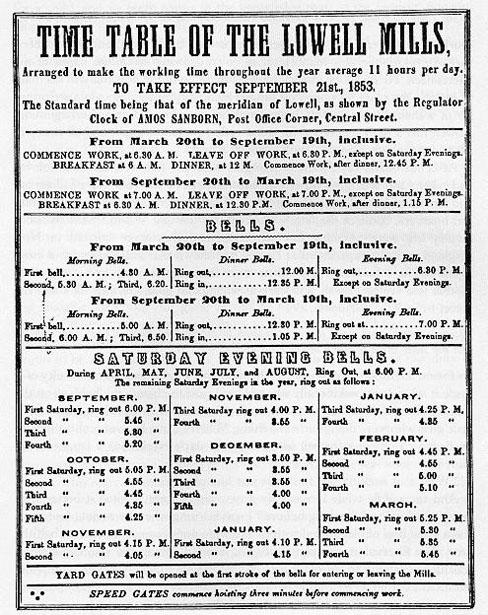
Time Table of the Lowell Mills

In response, the Lowell mill workers -- some as young as eleven -- did something revolutionary: the tight-knit group of girls and women organized a union. They marched and demonstrated against a 15 percent cut in their wages and for better conditions . . . including the institution of a ten-hour workday. They started newspapers. They proclaimed: "Union is power." They went on
strike.

As the movement spread through other Massachusetts mill towns, some 500 workers united to form the Lowell Female Labor Reform Association (LFLRA) in 1844 . . . the first organization of American working women to bargain collectively for better conditions and higher pay. Sarah Bagley was named the LFLRA's first president and she promptly led a petition-drive that forced the Massachusetts legislature to investigate conditions in the mills. Bagley not only fought to improve physical conditions, she argued that the female workers "lacked sufficient time to improve their minds," something
she considered "essential for laborers in a republic."

As with many revolutionary notions, the LFLRA met much opposition in their efforts. Despite their inability to secure the specific changes they demanded, the Lowell Mill Girls laid a foundation for female involvement and leadership in the soon-to-explode American labor movement and they continue to inspire those who stand against injustice today.


Mickey Z. is the author of several books including the soon-to-be-released There Is No Good War: The Myths of World War II (Vox Pop) and 50 American Revolutions You're Not Supposed to Know: Reclaiming American Patriotism (Disinformation Books). This essay was excerpted from 50 American Revolutions You're Not Supposed to Know. He can be found on the Web at <http://www.mickeyz.net>.
|
MR